How Ready Are You for Your Next CQC Inspection?
CQC inspection readiness isn’t just about being prepared when an assessment is announced. It’s about being able to demonstrate the quality and safety of your service every day.
For homecare providers, that means having effective governance in place, knowing where your evidence is, understanding what it demonstrates and being confident that everyday practice reflects your policies and procedures.
So, how inspection-ready is your organisation?
In this article, we’ll explore:
- What CQC Inspection Readiness Means in Practice
- What Evidence Providers Should Be Able to Demonstrate
- Common Gaps That Can Make Inspection Preparation More Difficult
- Why Governance and Oversight Matter
- How Digital Systems Can Support Continuous Readiness
- How to Assess Your Organisation’s Current Position

What Does CQC Inspection Readiness Actually Mean?
Being inspection-ready doesn’t mean constantly preparing for an inspection.
It means building the processes, oversight and evidence needed to demonstrate good care into everyday operations.
Under CQC’s current assessment framework, providers are assessed against five key questions:
Safe – Are people protected from abuse, avoidable harm and unsafe care?
Effective – Does care achieve good outcomes and support people’s health and wellbeing?
Caring – Are people treated with kindness, dignity, compassion and respect?
Responsive – Does the service respond to people’s individual and changing needs?
Well-led – Is the organisation effectively led, governed and committed to continuous improvement?
While CQC’s assessment approach is evolving, these five key questions remain central to both the current framework and the proposed Adult Social Care assessment framework.
For providers, the underlying challenge remains much the same: can you demonstrate the quality of the care and support you provide?
What Evidence Should Homecare Providers Have Available?
CQC doesn’t rely on a single source of evidence to understand the quality of a service.
Under the current assessment framework, evidence can come from people’s experiences, feedback from staff and leaders, feedback from partners, observation, processes and outcomes.
In practice, a homecare provider may need to demonstrate evidence across areas such as:
- Care planning and reviews
- Risk assessments
- Safeguarding
- Medicines management
- Incidents and complaints
- Recruitment and workforce records
- Training and competency
- Quality assurance and audits
- Feedback from people receiving care
- Governance and management oversight
- Learning and continuous improvement
- Outcomes for the people being supported
But inspection readiness isn’t simply about having these records.
The important question is whether your organisation can find, understand and demonstrate what the evidence is telling you.
Can You Find the Evidence You Need?
This can be one of the biggest differences between having evidence and being inspection-ready.
Information may exist, but if it is spread across different systems, spreadsheets, paper records or individual folders, retrieving it can become time-consuming.
Consider whether your team could quickly answer questions such as:
Where is the evidence?
Can relevant information be located without searching across multiple systems or asking several people?
Is it current?
Are care plans, risk assessments, training records and other key documents reviewed and updated when required?
Can you demonstrate oversight?
Can managers see trends, risks and areas requiring action?
Can you demonstrate improvement?
If an issue has been identified, can you show what happened next and whether the action taken made a difference?
Can you demonstrate outcomes?
Does your evidence show the impact of care on people’s lives, rather than simply proving that a task or process was completed?
These are useful questions to ask long before an inspection takes place.
Are Your Policies Reflected in Everyday Practice?
Having the right policies and procedures is important, but documentation alone doesn’t demonstrate quality.
Providers also need to be able to show that policies are understood, implemented and reflected in everyday care.
For example, an incident management policy may explain how incidents should be reported and investigated. But can you also demonstrate that incidents are consistently recorded, reviewed by the appropriate people, acted upon and used to identify trends or opportunities for improvement?
The same principle applies across safeguarding, medicines, complaints, staff training, risk management and care planning.
Inspection readiness is therefore about the connection between what your organisation says it does and what happens in practice.
Can You Demonstrate Learning and Improvement?
Strong governance isn’t just about identifying when something has gone wrong.
It’s also about what happens next.
When incidents, complaints, safeguarding concerns, audit findings or feedback identify an issue, providers should be able to demonstrate how they respond.
That might include:
Issue identified → Action taken → Follow-up → Outcome → Learning
This creates a clearer picture of an organisation that actively monitors quality and uses evidence to improve.
It also means managers need sufficient visibility across the organisation to recognise patterns that may not be obvious when individual records are viewed in isolation.

How Strong Is Your Governance and Oversight?
Good governance connects the detail of everyday care with the wider picture of service quality.
Leaders and managers should be able to understand what’s happening across the service without waiting for an inspection to trigger a major evidence-gathering exercise.
That includes being able to monitor areas such as incidents, complaints, safeguarding, workforce compliance, audits, risks and care quality.
Ask yourself:
If CQC asked us today how we know we’re delivering a safe, effective and well-led service, what evidence would we use to answer?
If answering that question requires significant manual work, it may indicate an opportunity to strengthen your governance and evidence processes.
What Are Some Common Inspection Readiness Gaps?
Inspection readiness gaps aren’t necessarily caused by an absence of policies or records.
Often, the information exists but isn’t being used as effectively as it could be.
For example, providers may find that:
- Evidence is stored across multiple locations
- Records aren’t consistently updated
- Audits identify issues but follow-up actions aren’t clearly documented
- Managers have limited visibility of trends across the service
- Feedback is collected but there is little evidence of how it informs improvement
- Processes are documented but evidence of implementation is harder to demonstrate
- Outcomes for people receiving care aren’t clearly captured
- Preparing evidence becomes a significant exercise when an inspection approaches
Identifying these gaps before an inspection gives providers an opportunity to address them as part of normal quality improvement.
How Can Digital Systems Support CQC Inspection Readiness?
Digital care management systems can help make evidence a natural output of everyday care delivery rather than something assembled retrospectively.
Care records, assessments, incidents, audits, workforce information, reporting and governance data can provide an ongoing picture of what’s happening across a service.
The right digital system can help providers:
- Maintain more consistent and accessible records
- Improve visibility of risks and trends
- Strengthen management oversight
- Maintain audit trails
- Monitor compliance and performance
- Bring evidence together more efficiently
- Demonstrate actions, learning and improvement
Technology doesn’t create good governance on its own. But it can make it significantly easier for providers to see what’s happening, identify where attention is needed and demonstrate the quality of their service.
How Can You Assess Your Current Inspection Readiness?
A useful starting point is to look objectively at how well your current practices, governance and evidence support the five CQC key questions.
Rather than waiting until an inspection is approaching, consider:
- What are we doing well?
- Where is our evidence strongest?
- Where do we have gaps?
- What would be difficult to demonstrate today?
- Which areas should we prioritise for improvement?
This is exactly what the OneTouch CQC Inspection Readiness Assessment is designed to help you do.
How Inspection-Ready Is Your Organisation?
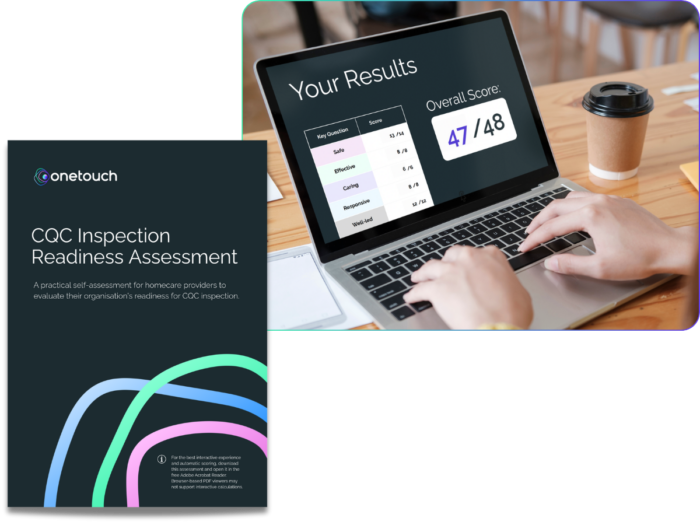
Our free, interactive CQC Inspection Readiness Assessment helps you evaluate how well your organisation’s everyday practices, governance and evidence support inspection readiness across CQC’s five key questions.
Complete the assessment, receive a score for each area and use the notes sections to identify evidence, capture gaps and turn your results into a practical, prioritised action plan.
Download the CQC Inspection Readiness Assessment
Inspection Readiness Should Be Continuous
Ultimately, inspection readiness isn’t about creating more paperwork or trying to predict exactly what an inspector will ask.
It’s about having confidence that your organisation can demonstrate the quality of its care at any time.
Good care already creates much of the evidence regulators need. The challenge is making sure that evidence is captured, accessible, understood and used to support effective governance and continuous improvement.
By identifying gaps early and embedding inspection readiness into everyday operations, providers can spend less time preparing for an inspection and more time focusing on the quality of the services they deliver.
See How OneTouch Can Support Inspection Readiness
Want to see how OneTouch can help you bring care delivery, compliance, evidence and governance together?
Book a personalised demonstration to see how OneTouch can help improve evidence visibility, strengthen oversight and support continuous CQC inspection readiness.